
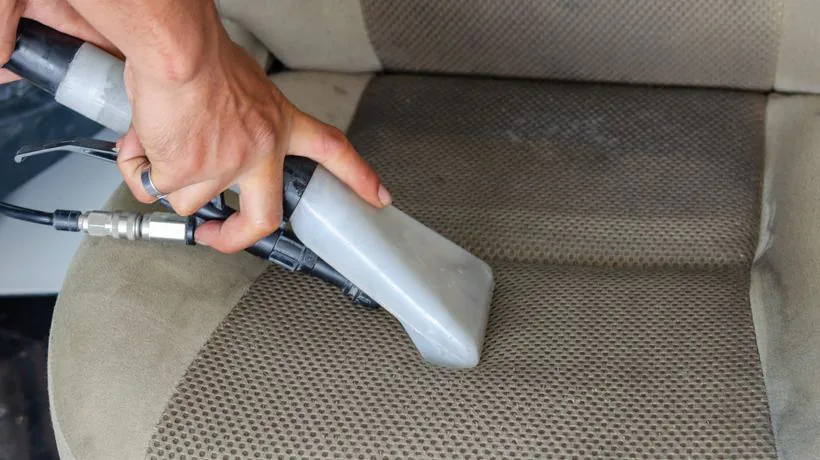
Professional car mould removal with us starts from £80. That starting price covers a car with light to moderate visible growth on the usual surfaces, treated on your driveway or at work with our own water and power, and with no call-out fee added. The figure rises when mould has spread across several materials, reached the headliner, or soaked into carpets that are still wet. This guide is only about money: what sets the price, what a fair quote should list, and which costs belong to someone else, such as the garage that fixes the leak.
What is the starting price, and what does it cover?
Our professional car mould removal service is priced from £80. At that level you are paying for the specialist part of the job: an inspection of seats, carpets, boot, door cards and roof lining, treatment of the visible growth with an anti-fungal product, high-temperature steam on the treated areas, a full vacuum and wipe-down afterwards, and an anti-microbial coating to slow regrowth.
The "from" matters. It describes a straightforward case on a normal-sized car. Most quotes move away from it for one or more of the reasons below, and a good valeter tells you which ones apply before starting work, never halfway through.
Which factors push the price up?
Five things account for nearly every difference between one mould quote and the next:
- How far it has spread. A few spots on one seat is a short job. Growth across every seat, the seatbelts, the carpets and the boot floor means hours of extra work.
- The materials involved. Hard plastics are quick. Fabric seats, deep-pile carpet and Alcantara take longer because the treatment has to be worked into the fibres and then lifted out again. Leather needs gentler products and more care.
- The headliner. Roof linings are bonded with adhesive that can let go if soaked, so they are treated slowly with minimal moisture. That care costs time.
- Wet carpets and underlay. If the carpet is still sodden, extraction and drying come first. Badly saturated underlay may need lifting, which is a bigger job.
- Vehicle size. A seven-seat MPV, campervan or van has far more surface than a city car.
The AA notes that seats and upholstery can be permanently damaged by mould, so waiting rarely saves money: the longer it sits, the larger and slower the job becomes.
What costs sit outside the cleaning quote?
Mould is a symptom of moisture. The AA names condensation as the main cause and links it to loose or damaged seals around doors, windows and sunroofs. Replacing a perished seal, unblocking a sunroof drain or fixing a leaking heater is mechanical or bodywork, so it belongs to a garage or dealer and is priced separately by them.
Please budget for both if you have an obvious leak. Paying for treatment while water is still getting in is the most common way people waste money on mould, because the conditions that grew it are still there. Our guide on finding and fixing water leaks into a car helps you spot the likely culprit before you book.
Other add-ons are optional. If the rest of the car also needs attention, combining the treatment with a full interior and exterior valet (from £80 on its own) is usually better value than two separate visits.
How do you get an accurate quote before the visit?
Clear photos do most of the work. Send pictures of every affected area in daylight, a wider shot of the cabin, and a close-up of the worst patch. Mention:
- the make, model and number of seats;
- whether carpets feel damp or wet underfoot;
- whether you can see marks on the roof lining or in the boot;
- any known leak, flood or the car having been stored for months.
With that information we can usually confirm a price range in advance. If we find something on the day that the photos could not show, such as soaked underlay, we tell you and agree the change before going further.
Is a cheap mould clean ever a false economy?
Often, yes. A quick wipe with household spray can lighten the stains on top while leaving growth in the fibres beneath, so the marks and smell return within weeks and you pay twice. Air fresheners and fogging alone mask the smell without removing the growth that causes it.
A fair professional quote should explain the steps, include drying time, and be honest about limits. Treatment removes visible growth and greatly reduces what remains, but nobody can promise to remove every last mould particle from a car, and anyone who does is overclaiming. Ask what happens if marks reappear, and whether the leak has been ruled out.
Does mould affect what your car is worth?
It can. The AA points out that visible mould could put potential buyers off, and a musty cabin is one of the first things people notice on a test drive. Spending from £80 on treatment, after the leak is fixed, is usually far less than the discount a buyer will ask for a car that smells of damp.
There is a health side too. UK government guidance on damp and mould says it mainly affects the airways and lungs, and that people with asthma, allergies or weakened immunity are at higher risk. Mould can aggravate allergies and asthma; see a GP for symptoms. If anyone who uses the car falls into those groups, that is a reason to deal with it sooner rather than later.
We cover Derby and the surrounding area, including car mould removal in Nottingham, Monday to Saturday, 9am to 5pm.
Sources
- AA: Rust, mould and scratch car body maintenance
- GOV.UK: Understanding and addressing the health risks of damp and mould in the home
Got mould or a musty smell in your car?
EMobile Valeting brings professional, fully insured mobile valeting to your door across Derby, Nottingham and the East Midlands. No call-out fee.
See Mould Removal Get a Free Quote