
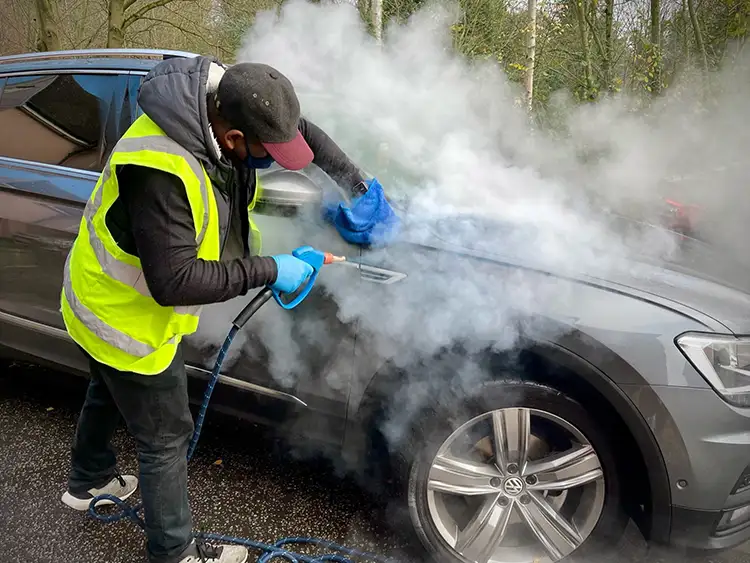
Commuting on the A52 or the M1 all winter leaves its mark where you rarely look. Under the bonnet, salt spray, oily dust and road dirt build into a layer that hides leaks and slowly attacks metal fixings. An engine bay clean strips that away. The engine has to be cold first. We then cover the air intake, alternator and fuse box, brush degreaser into the dirty areas and lift the grime with low-pressure steam, wiping sensitive parts by hand.
A pressure washer never comes near the engine, quite deliberately: blasting water at a plug or a sensor is the classic way to create an electrical gremlin. Prices for Borrowash start at £40 and scale with the size of the bay and the depth of the muck. Hybrids and EVs are fine, because the orange high-voltage cabling and the parts it feeds are left strictly untouched. Nothing is charged for travel, and the tap water and electricity are ours.
Gritted roads and the Borrowash engine bay
A good deal of local driving runs along trunk and A-roads: the A52 towards Derby and Nottingham, the A6005 through the village, and junction 25 of the M1 within easy reach. Derbyshire, as highway authority for Borrowash, treats its main routes when frost and snow are expected, and modelled figures for the area average 31 air frost nights and 5.7 snow days a year. Each gritting run sends salty spray up through the grille and wheel arches. It dries onto the bonnet underside, the radiator support panel, the battery tray and the brake fluid reservoir as a pale crust. Over a few winters it causes surface rust on brackets and makes rubber hoses look older than they are.
Damp winter air keeps the problem going. Salt residue under the bonnet stays tacky and active for much of the winter rather than drying to harmless dust, and leaves blown into the scuttle panel below the windscreen hold that damp against the metal. A thorough clean in spring removes it and gives you a clear view of the engine, so a seeping gasket or a coolant drip is obvious straight away. That matters before an MOT or a sale. Cars that only do short trips around the village are no exception, because a short run never gets the bay warm enough to dry out after a wet, salted drive.
Borrowash at a glance
| Distance from our base | 3.4 miles by road (2.3 miles as the crow flies), about 8 minutes off-peak, north-east of DE24 5BN |
|---|---|
| Postcode districts | DE72 |
| Frost (modelled) | 31 air frost nights a year on average |
| Snow (modelled) | 5.7 days a year with measurable snowfall |
| Postcode districts | DE72 |
Weather rows are modelled 2015 to 2024 averages for a grid cell that Borrowash shares with Breaston, Chaddesden, Chellaston and 7 other places we cover, not readings taken in Borrowash. Sources: road distance and drive time from OSRM routing on OpenStreetMap data; postcode and council data from postcodes.io; weather from the ERA5 reanalysis via Open-Meteo.
Engine bay cleaning around Borrowash, Ockbrook and DE72
Borrowash and the rest of DE72 are on our list, as are Ockbrook, Breaston, Risley, Spondon, Alvaston and Elvaston. Very little liquid is involved and hardly any drips reach the ground, which makes a driveway the natural setting; with 88% of homes in the small Census areas at the centre of the village detached or semi-detached, one is normally available. A roadside space works as long as the bonnet can go fully up without blocking the pavement. Give the car a rest of an hour or more before the appointment, or two hours after a long run up the M1. Power and water arrive on board.
Nearby villages
What Your Engine Bay Clean Includes
- ✓ Engine cool and inspected before we start
- ✓ Air intake, alternator and electrics covered
- ✓ Degreaser worked in with soft brushes
- ✓ Low-pressure steam, never a jet wash
- ✓ Slam panel and bonnet underside wiped
- ✓ Plastics and hoses dressed
- ✓ Dried thoroughly before the bonnet closes
- ✓ Before and after check with you
When to book, and what to avoid
Book in late March or April, after the last gritting of the season, so the full winter's salt comes off in one go. If you plan to sell, have the bay cleaned a week before taking photos or listing the car: it presents well, and any slow leak has time to show so you can be upfront about it. Before an MOT, a clean bay makes it easier to see fluid levels, hoses and components clearly. Bring the date forward if the car is being part-exchanged in spring.
Do not pressure wash the engine yourself between cleans, however tempting on a sunny afternoon. Water forced into the fuse box or an engine sensor can cause faults that take time to track down. Instead, wipe the plastic covers with a damp cloth a couple of times a year and check under the bonnet after long winter journeys. Let us know about any warning lights or recent repairs before we start.
From Our Google Reviews
"Best mobile car valet you can get in Derby. Honestly did a smashing job, went through every nook and cranny you can imagine and made sure it was all very well done. Lovely bloke as well."
Engine Bay Clean in Borrowash: Questions
It will not alter the outcome, but it makes the inspection easier. Hoses, fluid reservoirs and fixings are plainly visible on a clean bay rather than half hidden under grime, and an oil weep shows up in time for you to get it seen to beforehand. After a winter of gritted A52 miles the deposits can be heavy, so booking the clean a fortnight ahead of the test works well.
Cool enough to touch the engine cover comfortably, which usually means it has been off for at least an hour. After a long run on the M1, give it two hours. Steam and degreaser on hot metal can cause staining and uneven drying, and working around a hot exhaust manifold is a burn risk, so we will wait or reschedule if the engine is still warm.
Not necessarily. Old oil mist from a previous leak, a careless top-up or a breather can coat everything and stay for years. That is one of the best reasons for a clean: once the old film is gone, any fresh seep is easy to trace back to where it starts. If a new wet patch appears in the following weeks, show it to a garage, since we clean bays rather than repair them.