
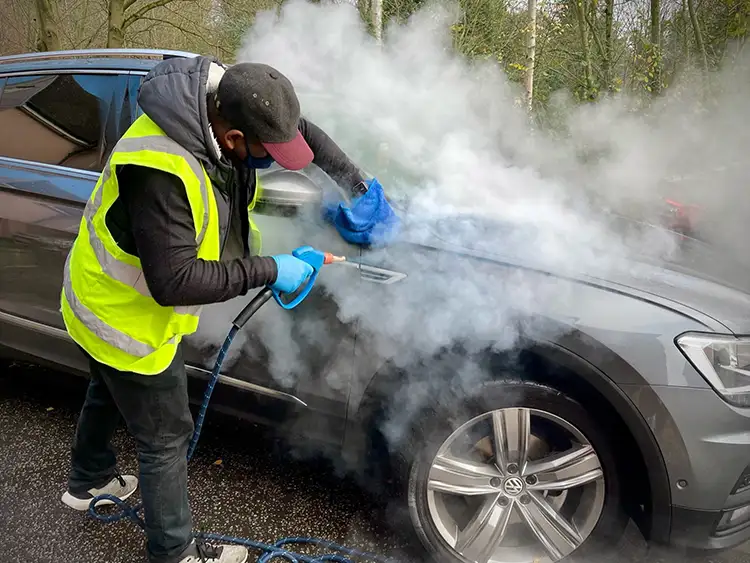
Pop the bonnet after a few Derbyshire winters and you can read the car's history in shades of grey. Crusted brine coats the inner wings, a film of oily dust dulls every plastic cover, and the scuttle is stuffed with leaves. We sort that out carefully. Once the motor has cooled, the intake, alternator and fusebox are wrapped up, then degreaser, detailing brushes and gentle steam do the work. A jet wash never comes near it.
It is practical rather than cosmetic. A clean bay lets you, your mechanic or an MOT tester see weeps and leaks clearly, and it helps a car look cared for when you come to sell. We carry water and power, so the work can be done on a Ripley drive or roadside space.
Frost, grit and Ripley's routes into the engine bay
Ice arrives early at 157 metres. Modelled climate data for the area gives Ripley about 34 frosty nights and 6.7 snowy days in a normal year, and Derbyshire, which is responsible for the roads here, sends its gritters along the A610 and A38 that many local drivers use daily. Front tyres fling that salty slush upward, and air rushing through the radiator grille carries a fine mist of it into the compartment, where it dries as a white crust on brackets, clips and the battery tray. Cars that also use junction 26 or 28 of the M1 in winter pick up the same spray at higher speed, so their bays tend to need the most work.
Left there, salt keeps attracting moisture, and in the damp months from October to January the underbonnet area rarely dries out properly. Over a few winters that encourages surface corrosion on bolts, clips and battery terminals, and leaves plastic covers patchy and grey. Cleaning it off in spring, once the gritting season is over, is sensible maintenance rather than vanity. A clean bay also makes it easier to see whether winter has left a split hose, a weeping gasket or a loose clip behind, and whether autumn leaves have built up in corners of the bay where they can trap water against metal.
Ripley at a glance
| Distance from our base | 15.9 miles by road (11.8 miles as the crow flies), about 23 minutes off-peak, north of DE24 5BN |
|---|---|
| Postcode districts | DE5 |
| Frost (modelled) | 34 air frost nights a year on average |
| Snow (modelled) | 6.7 days a year with measurable snowfall |
| Postcode districts | DE5 |
Weather rows are modelled 2015 to 2024 averages for a grid cell that Ripley shares with Eastwood, Heanor and Holbrook, not readings taken in Ripley. Sources: road distance and drive time from OSRM routing on OpenStreetMap data; postcode and council data from postcodes.io; weather from the ERA5 reanalysis via Open-Meteo.
Where we do engine bay cleans around Ripley
Anywhere in DE5 is fine: Butterley, Waingroves, Marehay and the middle of Ripley, plus Upper Hartshay, Lower Hartshay, Denby, Pentrich, Heage, Nether Heage, Swanwick and Codnor. Please leave the car standing beforehand so everything under the bonnet is cold to the touch; parking it up the night before is perfect. Driveways make life simple, and a level one is best, yet roadside works too if the space is lawful and leaves us room to lift the bonnet and walk round the nose. Everything we need, including water and electricity, comes on the van, so nothing is needed from the house.
Neighbourhoods
Nearby villages
What Your Engine Bay Clean Includes
- ✓ Engine cool and inspected before we start
- ✓ Air intake, alternator and electrics covered
- ✓ Degreaser worked in with soft brushes
- ✓ Low-pressure steam, never a jet wash
- ✓ Slam panel and bonnet underside wiped
- ✓ Plastics and hoses dressed
- ✓ Dried thoroughly before the bonnet closes
- ✓ Before and after check with you
Getting an engine bay clean right in Ripley
Tell us if the car is a hybrid or electric vehicle when you book. We keep well away from orange high-voltage cables and components, and plan the clean around them. If there is a known oil or coolant leak, mention it too, as cleaning first and checking a week later makes it easier to trace where the fluid comes from. If anything under the bonnet has been added since the car left the factory, such as extra wiring or an alarm, point it out when we arrive.
The best timing is late March or April, after the gritters have finished but before the summer. Booking a fortnight or so before an MOT also makes sense, as the tester gets a clear view. Avoid hosing the bay yourself with a pressure washer between visits; a dry brush on the plastics does more good. Autumn leaves are worth lifting out from under the wipers every so often, as the drains there carry rainwater away from the bay.
From Our Google Reviews
"Very good service. Very kind person. Done a great job and surely recommend."
Engine Bay Clean in Ripley: Questions
Leave it parked for a few hours beforehand, ideally overnight, so the engine is cold when we start. Make sure we can open the bonnet, either by leaving the keys or unlocking the car, and park somewhere level and lawful with room to walk round the front. If the car is on the road, a spot away from passing traffic is best. Nothing else is needed, as we bring the water, steam and power with us.
Not to the pass or fail criteria. What it does is give the tester an uncluttered view, and any new drip of oil or coolant shows up straight away against clean metal. Sellers find it useful too, since a tidy compartment suggests a car that has been looked after.
Yes. Diesels tend to build up soot and oil mist under the bonnet, and that dark film catches spray and grit from fast roads such as the A38 and the M1. Left alone it hides leaks and keeps grime damp against metal. We soak it with degreaser, work it loose with brushes and finish with gentle steam. A film that comes back unusually fast is worth mentioning to a mechanic.