
What does steam reach that a vacuum cannot? The grime pressed into seat stitching, the sticky film on a steering wheel, the dust packed into air vents and seat rails. Interior steam cleaning uses dry steam at roughly 100 to 120C at the nozzle to loosen that dirt so it can be wiped and extracted. Given enough dwell time, it also greatly reduces bacteria and dust mites in fabric. It goes deeper than a standard valet and is aimed at cabins that work hard every day.
In Derby we bring the steam unit, the water and the power to the car, so the job can happen on a residents' street as easily as on a drive. Steam leaves surfaces damp rather than wet, and seats are normally dry within a few hours. That makes it a sensible booking even when the sky is grey.
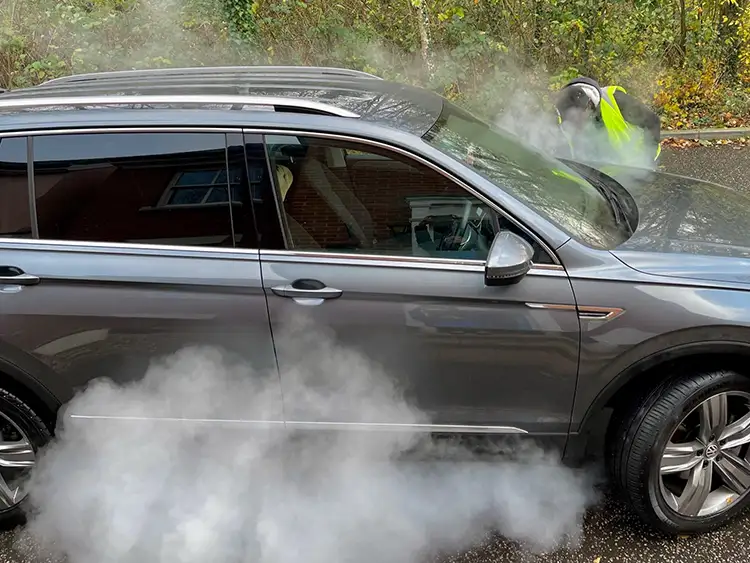
Why Derby's damp air and family cars suit a steam clean
Derby's air stays damp for a good part of the year. Modelled ERA5 averages for 2015 to 2024, which describe a regional grid square rather than a city weather station, put humidity at 81%, rising to 87% in January and 89% in December. Inside a closed car that moisture settles into seat foam and carpet, helped along by wet coats and boots brought in on rainy days. Dirt clings to damp fabric, and that is where stale smells start. Steam suits these conditions because it heats and loosens the soiling while putting very little water back in, so a seat comes out cleaner without being soaked. A traditional wet shampoo in December can leave the same seat damp for far longer.
Census 2021 figures for the 10 neighbourhoods closest to the city centre, which say little about the outer suburbs, show 22.5% of households with two or more cars. In those homes one of them may well be the family car: child seats, crumbs wedged into seat bases, a dog guard in the boot. That is the kind of cabin steam handles well, since it gets into buckles, rails and crevices a cloth cannot reach. Flats and other homes make up 28.7% of those central Census neighbourhoods, and a flat seldom comes with a drive or outside socket, so a self-powered service is the practical route. On a commuter car, the steering wheel, gear knob and door pulls get extra attention, since hands go back to them many times a day.
Derby at a glance
| Distance from our base | 6 miles by road (4 miles as the crow flies), about 11 minutes off-peak, north-west of DE24 5BN |
|---|---|
| Postcode districts | DE1, DE21, DE24, DE23, DE22 |
| Humidity (modelled) | 81% average relative humidity |
| Homes | 13% detached, 26% semi-detached, 33% terraced, 29% flats and other |
| Cars per household | 36% of households have no car, 22% have two or more |
Weather rows are modelled 2015 to 2024 averages for a grid cell that Derby shares with Findern, Littleover, Mackworth and Mickleover, not readings taken in Derby. Census 2021 figures cover the 10 Census 2021 neighbourhoods closest to the centre of Derby. Sources: road distance and drive time from OSRM routing on OpenStreetMap data; postcode and council data from postcodes.io; weather from the ERA5 reanalysis via Open-Meteo; ONS Census 2021 tables TS044 accommodation type and TS045 car or van availability via Nomis.
Where we can set up the steamer in Derby
The steam service runs across Derby, including Chaddesden, Oakwood, Darley Abbey, Mickleover, Littleover, Mackworth, Normanton, Sinfin, Chellaston and Alvaston, in the DE1, DE21, DE22, DE23 and DE24 districts. Because the work is inside the car, the doors stay open for most of the session, so park where we can reach both sides safely, ideally away from a busy through road. Near the centre, on-street parking is the usual set-up, and a drive suits us just as well. The steamer runs from our own power supply. If your road is hard to park on during the day, near the University of Derby for example, any nearby legal spot will do.
Neighbourhoods
What Your Steam Cleaning Includes
- ✓ Seats and upholstery steam cleaned
- ✓ Carpets and mats steamed and extracted
- ✓ Dashboard, console and door cards steamed
- ✓ Vents, cup holders and seat rails reached
- ✓ Boot floor and parcel shelf cleaned
- ✓ Interior glass finished streak-free
- ✓ Odour treatment where needed
- ✓ Drying time agreed before we leave
Before and after a steam clean
Take child seats out before we arrive if you can, as the fabric underneath and the belt buckles are among the dirtiest parts of a family cabin. Empty the door bins and boot. Tell us if the car has leather seats, a fabric headliner that has started to sag, or large touchscreens, as each needs a different approach: leather takes only moderate heat, headliner glue can soften under steam, and screens are wiped rather than steamed. If a dog travels in the car, mention it so we allow extra time for hair.
Afterwards, leave the windows open a crack for an hour or two if the car is somewhere secure, or run the heater with the fan on fresh air. From April to August the air is at its driest, so seats dry faster and that stretch is a good time for the deepest work. A steam clean once or twice a year, with regular valets in between, keeps a family car manageable. Wait until the seat base feels dry before refitting child seats.
From Our Google Reviews
"Fantastic job. Spotless inside and out. Would definitely recommend."
Steam Cleaning in Derby: Questions
Yes, though it takes a little longer than in summer. Dry steam leaves fabric damp rather than soaked, so seats are normally fine to sit on within a few hours. In midwinter, running the heater on fresh air or leaving a window slightly open afterwards helps. We keep moisture low throughout for exactly this reason.
Usually, yes, if we know about it. The worst is lifted out first, then steam loosens what has soaked into the fabric and seams so it can be extracted, and with enough dwell time the heat greatly reduces the bacteria behind the smell. A spill that reached the foam underneath may need more than one pass. Tell us what it was and how long ago it happened, because fresh spills come out more easily.
It is, with the right technique. Leather gets moderate heat and short passes followed by a wipe, to avoid overheating the hide. Infotainment screens and instrument panels are never steamed directly; we clean those with suitable cloths instead. Headliners need care because the adhesive can let go if it gets too hot or wet, so they get a light touch.
More Services in Derby
Steam Cleaning Nearby
- Darley Abbey 1.3 miles north
- Allestree 1.4 miles north-west
- Chaddesden 1.8 miles east
- Mackworth 2.2 miles west
- Littleover 2.2 miles south-west
- Spondon 2.3 miles east