
To clean a car roof lining, vacuum or brush it dry first, then spray a small amount of mild upholstery cleaner onto a microfibre cloth, not onto the headliner, and blot the mark gently. Wipe once with a clean damp cloth and let it air dry. The key rule is to keep it as dry as possible. Most headliners are thin fabric glued to a foam-backed board, and soaking or scrubbing breaks down that adhesive, leaving a lining that droops. This guide covers the safe method, common stains and when to leave it to a professional.
Why are roof linings so easy to damage?
A typical headliner has three layers: a moulded board shaped to the roof, a thin foam layer, and the face fabric glued on top. The weak point is that glue and foam. When liquid soaks through the fabric, it softens the adhesive and the foam can start to crumble, so the fabric separates and hangs down. Once that happens, cleaning cannot fix it; the lining needs re-covering.
Gravity makes things worse. Anything you spray upwards runs, collects in one spot and soaks in deeper than you meant. Heat has a similar effect on the adhesive, which is why we never park a hot steam head on a headliner.
What do you need to clean a headliner?
- a vacuum with a soft brush attachment
- a soft upholstery brush or a clean, soft detailing brush
- a mild fabric or upholstery cleaner, diluted as the label says
- three or four clean microfibre cloths
- a bowl of clean water for the rinse cloth
Avoid all-purpose degreasers and household sprays. Nissan's owner's manual, for example, advises removing loose dust from interior trim with a vacuum cleaner or soft-bristled brush, and warns against solvents and harsh cleaning fluids on interior surfaces. Read your own handbook, as some headliners are suede-effect or perforated and need extra care.
How do you clean a car roof lining step by step?
- Dry clean first. Vacuum the whole lining slowly with a soft brush head, using light pressure.
- Test the cleaner on a hidden area, such as behind a sun visor, and let it dry to check for marks.
- Load the cloth, not the roof. Mist cleaner onto a folded microfibre so it is damp but not wet.
- Blot the mark with gentle pressure. Move in straight lines in one direction, never circles, which can bobble the fabric.
- Lift residue with a second cloth dampened in clean water and well wrung out.
- Dab dry with a dry cloth.
- Air the car with the doors open until the lining is dry to the touch, then brush the nap gently in one direction so it looks even.
Work in sections and blend the edges, so you do not leave a clean patch with a ring around it.
How do you get smoke yellowing out of a headliner?
Cigarette and vape residue rises and settles on the roof, leaving a yellow-brown film and a stale smell. The NHS notes that smoke can linger in the air for hours after a cigarette, even with a window open, and that secondhand smoke can reach hazardous levels in a car even with the windows open. It is also against the law to smoke in a private vehicle with anyone under 18 present.
Smoke film usually needs several light passes with the cloth method rather than one heavy one. Change cloths often, because they pick up the yellow residue quickly. For the smell itself, cleaning the headliner helps but the residue is also in seats, vents and carpets; our guide on getting rid of a cigarette smell in a car covers the whole cabin.
What causes brown water marks on the roof lining?
Tide marks near the sunroof, the top of a pillar or the roof aerial almost always mean water is getting in. Common causes are blocked sunroof drain tubes, a perished seal around the sunroof or windscreen, or a leaking aerial base or roof rail fixing. Cleaning the mark without fixing the leak only buys time.
Check after rain whether the lining is damp, and clear or replace the drain or seal before cleaning. Damp linings can also grow mould, which can aggravate allergies and asthma; see a GP for symptoms. Our guide on getting rid of a damp smell in a car explains how to trace leaks.
When should you leave the headliner to a professional?
Stop and get help if the fabric is already loose or bubbling, if the stain covers a large area, or if the lining is suede-effect or perforated. Large areas are hard to clean evenly by hand without over-wetting.
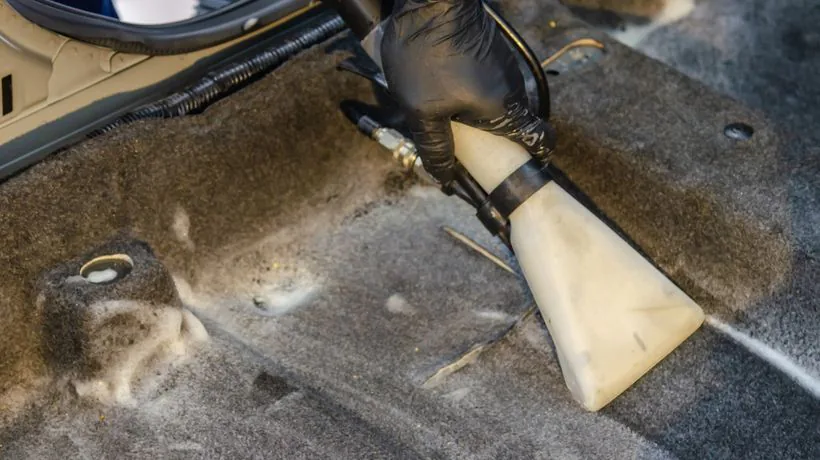
On a visit we clean headliners with low-moisture methods: dry brushing and vacuuming, cleaner applied to a cloth, and where it suits the fabric, brief controlled passes of a towel-wrapped steam head that keep moving and never linger. We include the roof lining in our steam cleaning service from £60, and in our full interior and exterior valet from £80. If a lining is already sagging, that needs a trimmer to re-cover it rather than a valeter.
Sources
Marks on your roof lining?
EMobile Valeting brings professional, fully insured mobile valeting to your door across Derby, Nottingham and the East Midlands. No call-out fee.
See Steam Cleaning Get a Free Quote