
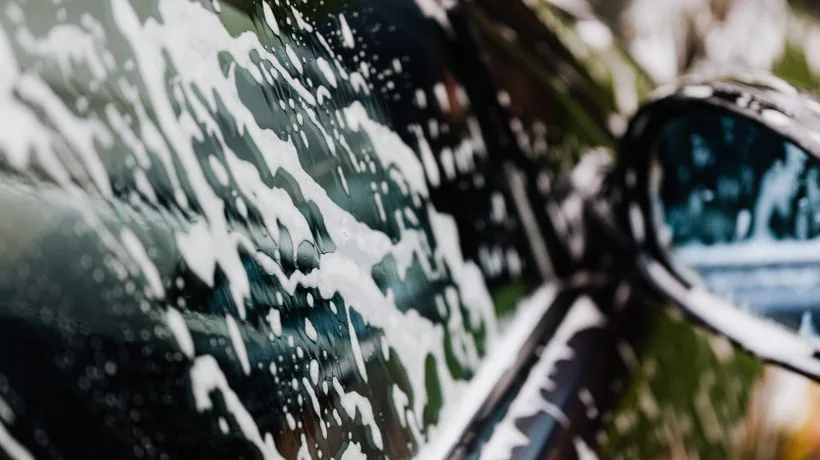
Snow foam is a car cleaning product made mostly of water and surfactants, the same family of chemicals that makes shampoo and washing-up liquid work. Applied through a foam lance or gun, it is mixed with air into a thick foam that sticks to the bodywork instead of running straight off. While it sits there, the surfactants work their way under dirt and loosen it, and rinsing then carries much of that dirt away before you touch the paint. The rest of this guide explains what is in it and why it works.
What is actually in a bottle of snow foam?
Formulas vary by brand, but most contain the same building blocks:
- Surfactants, the active cleaning ingredients, usually a blend chosen for both cleaning and foaming.
- Foam boosters and thickeners, which make the foam denser and slow its slide down the panels.
- Water softening agents in some products, which stop minerals in hard water reducing the foam and leaving spots.
- pH adjusters. Many foams are pH neutral. Others are mildly alkaline for a stronger clean.
- Dyes and fragrance, which are cosmetic.
Autoglym, for example, describes its Polar Blast foam as pH neutral and states that it does not remove previously applied waxes or sealants. The concentrate is diluted with water in the foam bottle, and the ratio is part of what decides how thick the foam comes out.
How do surfactants loosen dirt?
Plain water is poor at cleaning a car because road grime is partly oily, and oil and water do not mix. Surfactants solve that. The Key Centre for Polymer Colloids at the University of Sydney explains that a surfactant molecule has a hydrophilic, water-loving head and a long hydrophobic, oil-loving tail.
When snow foam lands on the paint, those molecules line up at the boundary between the water and the greasy film. The tails push into the oily dirt while the heads stay in the water. This lowers surface tension, so the liquid wets the paint more evenly and creeps underneath particles of grit. Greasy dirt gets broken into tiny droplets surrounded by surfactant, which keeps them suspended so they rinse away rather than settling back on the paint. The same source notes that this behaviour at surfaces is what produces wetting, foaming and detergency.
Why is it applied as foam rather than a spray?
A liquid sprayed on a vertical door runs off in seconds, so it has little time to work. Turning the solution into foam traps it in millions of small bubbles that cling to the panels. That slows the run-off and gives the surfactants what valeters call dwell time.
The foam itself is not doing the cleaning. Very thick foam looks impressive, but a slightly wetter foam can actually release cleaner onto the surface more readily. What matters is that the product stays wet and in contact for several minutes. As it slowly slides down, it carries loosened grit with it, which is why panels often look cleaner even before the rinse.
Foam is made by forcing the diluted product and air through a mesh inside a foam lance on a pressure washer. Hose-fed foam guns and pump sprayers make a runnier foam that still helps, just with shorter cling time.
What is the difference between neutral and alkaline foams?
pH-neutral foams are gentle on wax, sealants and sensitive trim, which makes them the sensible choice for regular maintenance washes.
Alkaline pre-wash products, sometimes sold as traffic film removers or citrus pre-washes, break down oily road film more aggressively. They are useful on a very dirty car or before a full decontamination, but they can wear protection faster and should not be left to dry on paint, glass or plastics.
Neither type will remove everything. Tar, iron fallout from brakes, tree sap and old bird droppings are bonded too strongly and need dedicated products, which is the territory of a decontamination wash.
How do you use snow foam correctly?
Autoglym's directions for its foam give a good general pattern:
- Check the bodywork and wheels are cool to the touch and out of direct sunlight.
- Spray from the bottom up, covering all exterior surfaces including glass and wheels.
- Leave it to dwell and loosen dirt for up to 10 minutes, but do not allow it to dry.
- Rinse thoroughly, again from the bottom up.
Working from the bottom up means the dirtiest areas get the longest soak and the foam is not running down over panels that have not yet been coated. Foam is a preparation stage, so a gentle mitt wash normally follows. Our guide on whether you still need a contact wash after snow foam explains when you can skip it.
Is snow foam bad for the environment?
Any car wash water carries detergent and road dirt. NetRegs guidance says vehicle wash run-off must not reach surface water drains, rivers or groundwater, and recommends choosing biodegradable, phosphate-free detergents. At home, wash on gravel or grass where possible rather than letting water run into a road gully, and use only as much product as the dilution needs.
On a mobile car valet we use a pre-wash stage before the contact wash and bring our own water, so nothing is drawn from your supply.
Sources
- Key Centre for Polymer Colloids, University of Sydney: Introduction to Surfactants
- Autoglym: Polar Blast 2.5L
- NetRegs: Vehicle cleaning (including wheel washing)
Want a safe, thorough wash?
EMobile Valeting brings professional, fully insured mobile valeting to your door across Derby, Nottingham and the East Midlands. No call-out fee.
See Car Valeting Get a Free Quote